This debate gets dramatic online, but the answer is not “React Native is best” or “Native is best”. The answer depends on product goals: speed to market, performance needs, device feature usage, and long-term roadmap.
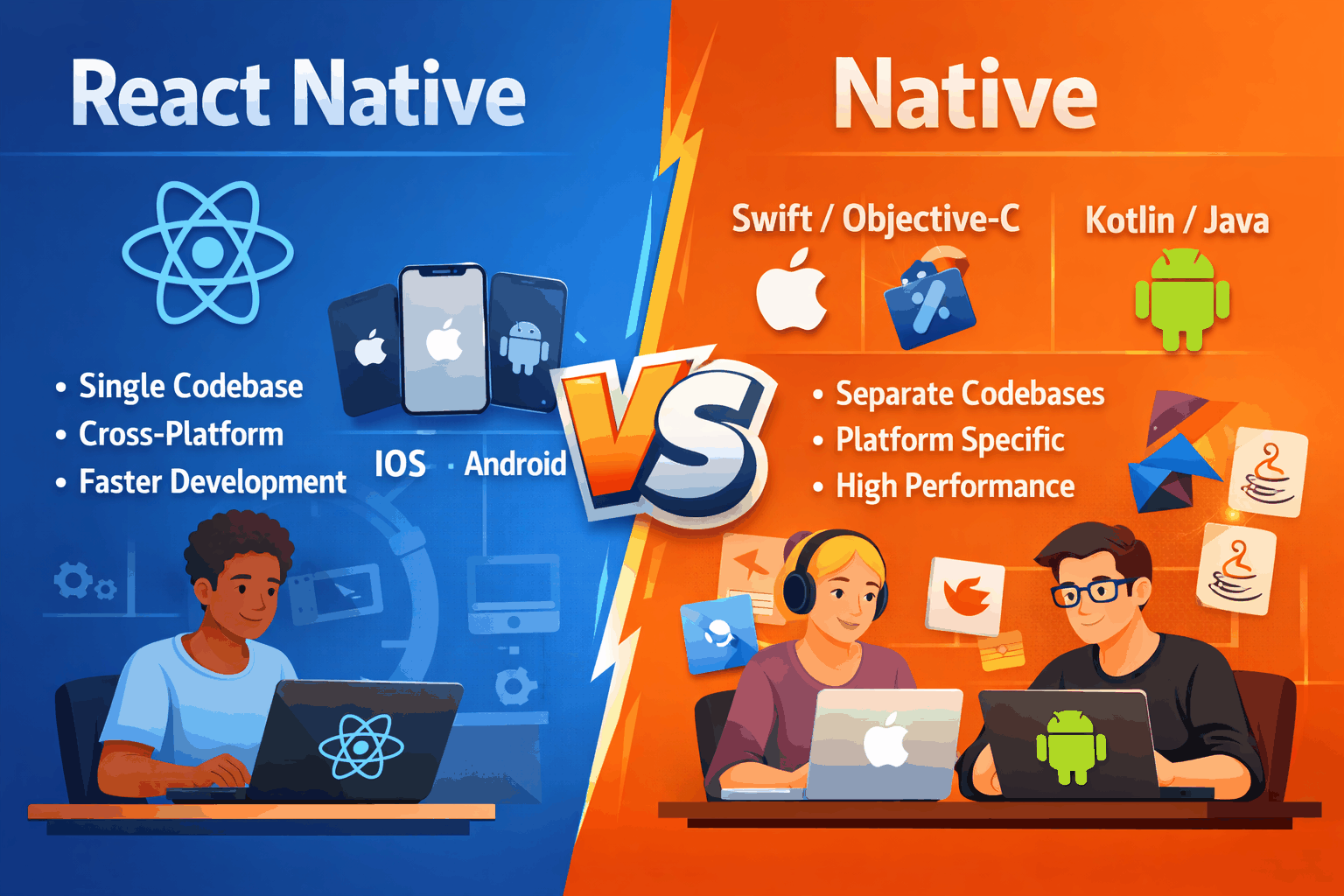
When React Native is a strong choice
- You want faster development for both Android + iOS.
- Your app is product or service focused (dashboards, booking, commerce, content).
- You want one codebase and easier maintenance.
- You want rapid iteration and frequent updates.
When native development is worth it
- You need heavy performance (high-end gaming, advanced 3D, complex video processing).
- You rely deeply on platform-specific UI/UX patterns.
- You need cutting-edge hardware features from day one.
What most businesses do (smartly)
Many teams launch with React Native to validate the product quickly, then optimize performance-critical modules with native components if needed. This hybrid approach often gives the best of both worlds.
Choosing tech is not about ego. It is about risk and return.
Reliability is the difference between an app users keep and an app users uninstall. Real-world conditions include bad internet, low battery, background restrictions, and device fragmentation. A reliable app handles these conditions gracefully.

Offline-first mindset (without complexity)
- Local cache: store essential data on-device so the app stays usable.
- Queued actions: user actions are stored and synced when internet returns.
- Conflict handling: define rules when the same data changes in two places.
Sync that doesn’t break trust
- Clear status: show “Syncing…” or “Saved locally” so users feel in control.
- Retry logic: failed requests should retry quietly, not force user rework.
- Data integrity: avoid duplicate records using unique IDs and server validation.
Crash-free releases: what good teams do
- QA on real devices (not just emulators).
- Automated sanity testing on core flows.
- Crash reporting and performance monitoring enabled.
- Staged rollout so you can stop issues early.
Reliability is a feature. And it is the most underrated one.
Building an app is exciting. It is also where businesses burn budget fast if they skip clarity. The secret is not “more features”. The secret is building the right core flow, validating it early, then scaling.
A roadmap that works for most products
- Discovery: user goals, competitors, and success metrics.
- MVP scope: the smallest version that delivers real value.
- UX/UI: clean screens, smooth navigation, and clear user actions.
- Development: agile sprints with weekly demos.
- QA testing: functional testing + device testing + crash checks.
- Launch: store listing, analytics, performance monitoring.
- Improve: measure usage, refine onboarding, add features with real data.
Where apps usually go wrong
- Trying to build a “final product” in version 1.
- No clear user roles or permissions (admin, customer, staff).
- Weak onboarding and login flow.
- Skipping analytics, so decisions are guesswork.
- Not planning backend APIs properly (which delays everything).
A good MVP is not a cheap app. It is a focused app.